
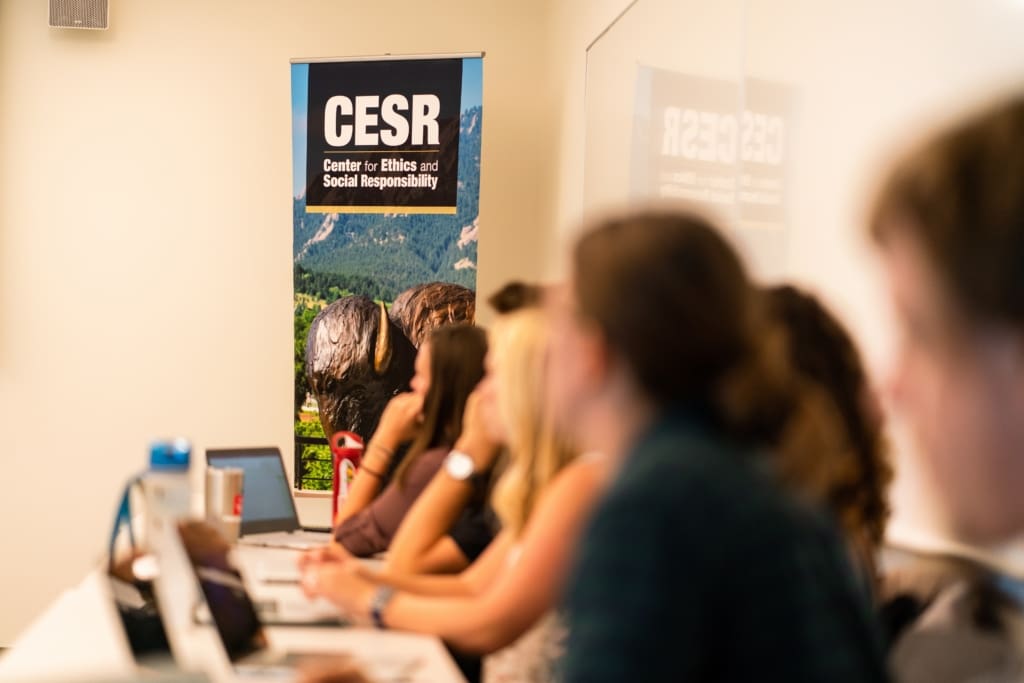
Students participate in a sustainability consulting workshop at the Leeds School of Business’ Center for Ethics and Social Responsibility at the University of Colorado Boulder. The school will launch a new nine-month Master of Science in Sustainable Business in fall 2026.
University of Colorado Boulder is launching a new nine-month, standalone Master of Science in Sustainable Business that will produce graduates who can tackle climate and sustainability challenges from both managerial and technical angles.
Leeds School of Business will enroll its first cohort of about 25 this fall. The program will launch alongside a parallel Master of Science in Sustainable Engineering from the College of Engineering and Applied Science. Together, the programs are intended to build a cross-college pipeline, bringing together expertise from business, engineering, and the natural sciences to train graduates for the growing demand for sustainability professionals.
“We are known as a school that has deep roots in sustainability and we are in a community that really supports that work. Boulder embraces these ideas, not only as ideals or values, but also through the industries that come here,” says Kristi Ryujin, Associate Dean for Graduate Programs.
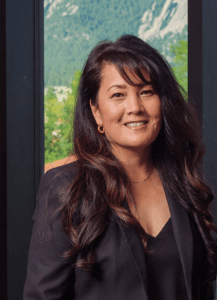
Kristi Ryujin, Associate Dean for Graduate Programs
“Students come to CU-Boulder from all across the country and globe for those reasons. This new sustainable business degree, in conjunction with the new MS in Sustainable Engineering, will help to support the demands of our industry partners in this state and region.”
BUSINESS MEETS ENGINEERING
The two master’s degrees were deliberately designed in tandem to reflect the interdisciplinary nature of sustainability work in the real world.
The degrees share six common courses as part of the core, exploring topics such as environmental systems, policy design, leadership for sustainability transitions, sustainable technology design, and data analysis for sustainability decision-making. Business, engineering, and environmental science students will take these classes together. (Leeds has also been working with CU’s College of Arts and Science to develop the integrated core.)
“When you look at the national market, there are colleges that place sustainability degrees squarely within the business school, or at the campus level they ask students to take a course here, a course there, and another course somewhere else. Then, they call it an interdisciplinary degree,” says Vijay Khatri, dean of Leeds School of Business.
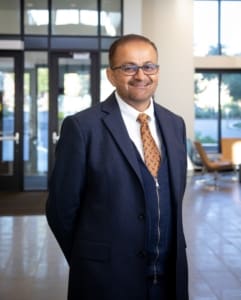
Vijay Khatri, dean of the Leeds School of Business
“That is not what we had in mind. We didn’t want students to do the stitching of the interdisciplinary work. We wanted the faculty to do the stitching. So when you think about the integrated core, it is problem-based, not discipline-based.”
Each core week will end with “integrated Fridays,” where faculty from all participating colleges jointly connect the material and apply it to real-world problems presented by industry partners. Say, for example, students were asked to analyze the Marshall Fire, a 2021 wildfire that killed two people, evacuated 37,500 more, and burned more than 1,000 homes and businesses. Students could study the fire from a science, engineering, and business perspective through the week, then come together on Friday to connect the content.
Students will also complete a joint capstone in which business, engineering, and science students tackle complex sustainability challenges.
In other words, the classroom is meant to simulate the cross-functional reality graduates will face on the job.
“In a business setting, you need to know how to interact and interface with engineers. You need to know how to interface with R&D scientists, and you also need to know how to interface with people within the business,” Khatri says.
Beyond the integrated core, each degree has its own electives for further specialization.
SUSTAINABILITY AS CORE BUSINESS STRATEGY
The program emerges amid an evolving debate about sustainability in business education. Rather than treating climate and ESG as niche concerns, Leeds leaders recognize they are becoming embedded across every function, from finance and operations to marketing and supply chains.
Khatri describes two parallel needs: integrating sustainability concepts across traditional business courses while also training specialists for sustainability-focused roles.
“There needs to be some element of sustainability in almost every course,” he says, while also recognizing demand for professionals whose careers will center on sustainability itself.
The specialized degree provides formal training for a growing workforce that has largely learned on the job. Ryujin notes that 68% of those currently working in sustainability roles do not have sustainability backgrounds.
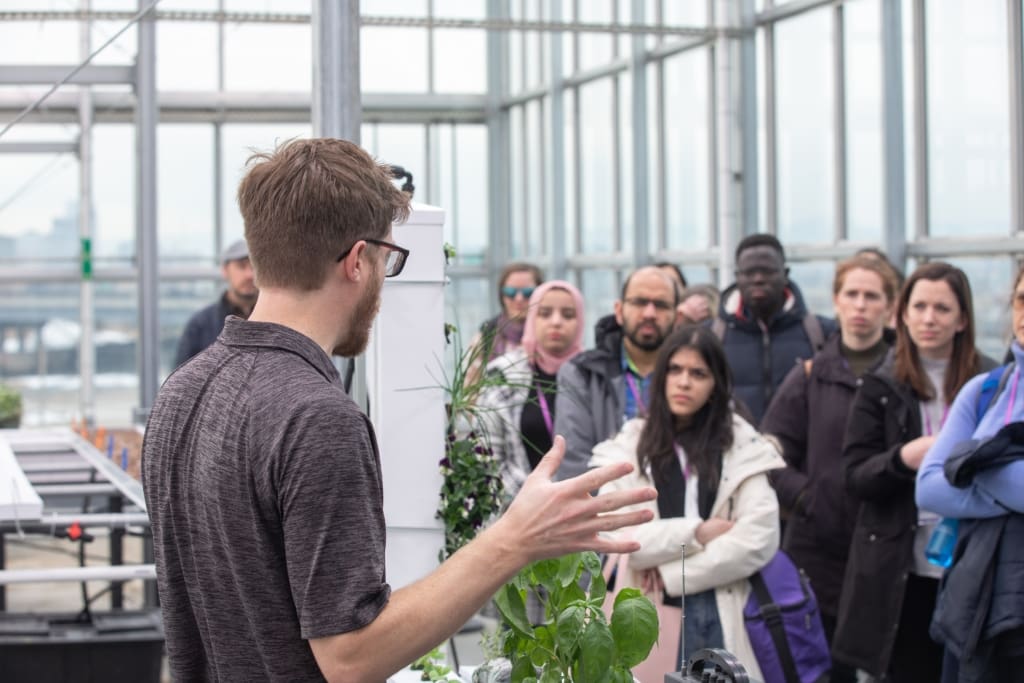
Students visit a greenhouse during a sustainability-focused academic trek at the University of Colorado Boulder. While the Leeds MBA has sustainability pathways, the new degree will be a stand-alone master’s students can complete in nine months.
LEVERAGING BOULDER’S CLIMATE TECH ECOSYSTEM
Leeds’ program compresses 30 credit hours into nine months, allowing students to enter the workforce in less than a year. Neither a business nor engineering background is required, and leaders expect applicants from a wide range of undergraduate majors – from business to environmental science, from public policy to more technical fields. Students will complete pre-program boot camps in Excel, Python, and statistics.
Current CU Boulder seniors with a Leeds major or minor and a GPA of 3.0 or higher qualify for automatic admission.
Graduates will be trained for roles ranging from sustainability director and ESG analyst to climate consultant, product manager, or supply chain specialist, positions increasingly embedded throughout organizations rather than confined to standalone sustainability offices. Employers are also looking for professionals who can translate environmental initiatives into measurable business outcomes, regulatory compliance, and operational improvements.
Sustainability is one of CU Boulder’s four institutional priorities, and the degree will leverage this ecosystem. The university earned a STARS Gold rating for sustainability in 2025 and ranked among the top 15 U.S. universities for sustainability in 2024. It was the first U.S. campus with a student-run Environmental Center (established in 1970) and was among the first universities to commit to carbon neutrality (in 2007).
Last year, it established the Buckley Center for Sustainability Education with a $10 million gift to drive campus-wide curriculum innovation and deepen student engagement around environmental and climate issues. It also launched Boulder Climate Ventures, an interdisciplinary program led by the Center for Ethics and Social Responsibility (CESR) and Leeds’ Deming Center for Entrepreneurship. Boulder itself hosts a dense ecosystem of climate-tech startups, research labs, outdoor industry companies, and environmental organizations.
Leeds is now accepting applications for the Master’s in Sustainable Business, which will start classes this fall. Learn more here.
DON’T MISS: GMAC’S BLUNTEST SURVEY YET: U.S. LOSING GLOBAL TALENT, CANDIDATES WANT PROOF NOT PROMISES AND THE P&Q INTERVIEW: AACSB CEO LILY BI ON AI, ENROLLMENT DECLINES & THE FUTURE OF BUSINESS EDUCATION
The post This New 9-Month Master’s Is Designed To Fast-Track Grads Into Climate & Sustainability Careers appeared first on Poets&Quants.