
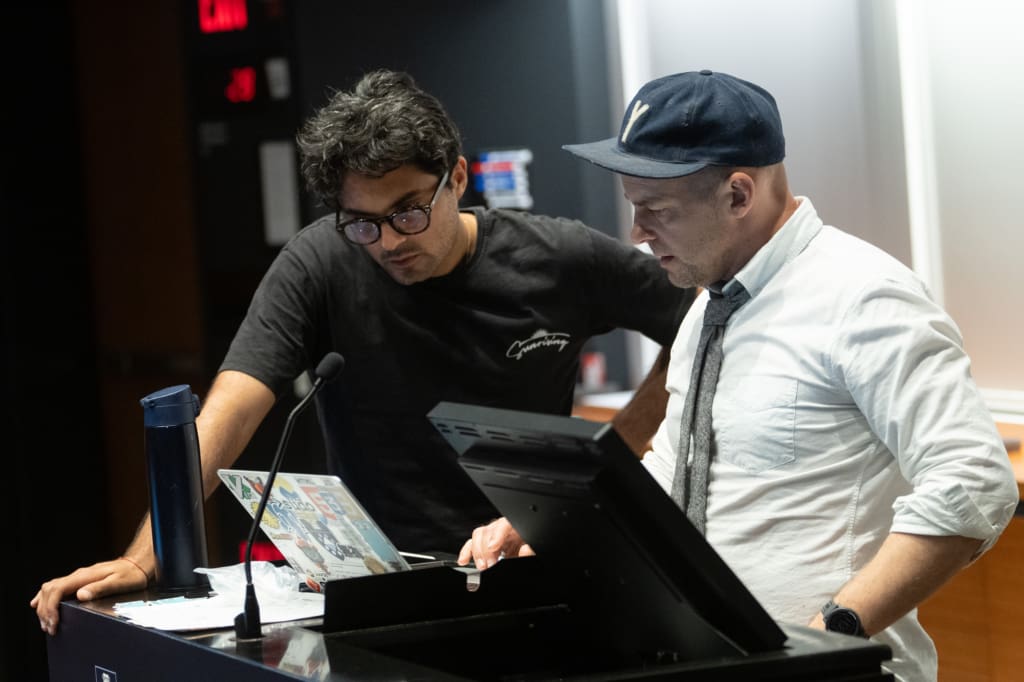
Kyle Jensen (right), Shanna and Eric Bass ’05 Director of Entrepreneurial Programs at the Yale School of Management, works with a student. Jensen’s courses increasingly bring business and engineering students together to build AI-powered tools and startups.
Walking into Kyle Jensen’s software development course at Yale School of Management, Austin Zheng expected another lecture. Instead, he got a stopwatch.
Jensen challenged roughly 75 SOM students to use AI to build a functioning website in just 20 minutes, after just four lectures on web development up to that point. Zheng, who had spent years working alongside engineers but had never written production code himself, couldn’t believe the results.
“I was blown away by what my classmates created using tools like Gemini’s canvas function,” says Zheng, a Class of 2026 Master of Management student in Global Business and Society. “That was the moment I felt the barrier to entry collapse and I could finally build my passion project.”
Today, Zheng is building Artopath, an application he describes as a “personal cultural map” that connects users’ digital interests in film and art to real-world locations.
The leap from tech-adjacent product strategist at Lenovo to hands-on builder is the kind of shift Yale SOM is trying to accelerate. Over the past several years, Yale leaders have deliberately tightened connections between management and engineering through new joint degrees, cross-listed coursework, shared AI tools and computing resources, and more programs that help students launch startups.
“The reality is that so much great economic progress and progress in humanity is driven by innovation in terms of science and technology. It just seemed very relevant for us to be teaching not just management of organizations, but management organizations that have some kind of component like that,” says Jensen, SOM’s Shanna and Eric Bass ’05 Director of Entrepreneurial Programs.
“Our mantra is training leaders for business and society, creating leaders and managers who give a darn about the world and want to make it a better place. It’s a huge opportunity to do that in businesses that have a technological component.”
ENGINEERING GAINS AUTONOMY
Yale SOM has a long track record of close collaboration with other Yale academic schools, particularly School of the Environment, the School of Public Health, the Law School, and the School of Medicine. But, it’s working relationship with engineering was somewhat constrained by school structure. For decades, the Yale School of Engineering & Applied Science (SEAS) was embedded within the Faculty of Arts and Sciences. It had its own dean, but there were several layers of priorities, visions, and decision makers to go through.

Jeffrey Brock
In July 2022, SEAS became an autonomous, stand-alone school, giving it clearer authority to define its priorities and strategy.
“A lot of that transition and growth that we’re experiencing has to do with a strategic vision that we put together with a faculty-led committee,” says Jeffrey Brock, SEAS dean. “A big element of that strategic vision was to increase the external portfolio of the school, to be more focused on entrepreneurship, to be more focused on industrial collaboration, and to give our students and our faculty an opportunity to think about the impact of their work.”
The move opened the door to deeper collaboration with Yale’s professional schools, including the School of Management. While the university has long been strong in life sciences commercialization, particularly in medicine, Brock says that the push into deep tech is newer. Independence allows SEAS to work much more closely with Yale SOM on the shared goal of moving ideas from lab to market.
“We are maybe overdue for an injection of energy in that direction, at least as far as engineering is concerned,” he says.
TWO NEW SOM DEGREES WITH ENGINEERING
One of the most tangible signs of this closer relationship is the launch of two new joint degrees with engineering. The new joint MBA/MS program launched in Fall 2024, allows candidates to earn an MBA alongside an MS in disciplines like applied physics, biomedical engineering, chemical and environmental engineering, computer science, and others. Students are to both SOM and SEAS.
“They will come to SOM first, spend the first year in the MBA environment, and then the second year will be mainly taking the advanced courses in engineering,” says Edieal J. Pinker, the BearingPoint Professor of Operations Research at SOM.

Edieal J. Pinker
“And they will walk out of here with two degrees in two years for the price of one two-year degree.”
The program is deliberately small, maxing at around 20 students, reflecting both the program’s selectivity and positioning. Yale is targeting candidates who can clear the admissions bar on both sides of campus, not business students dabbling in tech, nor engineers picking up surface-level management skills.
From the engineering perspective, the degree also fills a strategic hole. Brock notes that peer institutions, including Harvard and University of Pennsylvania, have long cultivated technically fluent investors, operators, and founders, a lane Yale is now more intentionally entering.
SOM has also rolled out a second degree designed to capture technical talent already on campus. The one-year Master’s in Technology Management, launched in 2023, is aimed primarily at Yale engineering and applied science undergrads who want to layer leadership and business fluency onto their technical training. Grads and recent grads complete a concentrated year of management coursework intended to position them for roles that demand more than narrow technical skill.
“It’s a possibility that we would open this to the broader world of engineering students,” Pinker says. But for now, the controlled launch allows Yale to test demand and refine the model while ensuring that promising technical students don’t have to leave Yale for management skills in AI and tech industries.
SEAS is also eyeing other degrees in can offer with SOM, including more targeted Master of Engineering programs tied to specific tech domains, Brock says. These could be paired with externships that place students directly inside companies or startups.

Malone Engineering Center at the Yale School of Engineering and Applied Science (SEAS).
CROSS-LISTED COURSES
SOM and SEAS are also offering a growing list of cross-listed courses, particularly in entrepreneurship and computer science. One example is Software Engineering II, a joint course that deliberately mixes management students with CS majors.
“Management students join essentially young hackers from the CS school in the creation of cool code,” says Jensen. “I just really enjoy seeing those two communities together.”
In fall 2023, Jensen and a colleague launched a Large Language Models course that goes well beyond prompt engineering. The class teaches students how generative AI systems actually work and how to build them.
But, rather than a sweeping “AI-first” rebrand, faculty are continually updating syllabuses and course content to stay current. A social media analytics class, for example, has evolved into a hands-on exercise where students build AI-powered agents. Quantitative and statistics courses increasingly incorporate generative tools for data manipulation and modeling.
“The course title may not change that much, but the content changes,” Pinker says. “Faculty want to be on the cutting edge. They don’t want to teach a course that’s irrelevant.”
Yale has also committed $150 million over five years to artificial intelligence initiatives, including investments in computing infrastructure that both engineering faculty and startup teams are already using. SOM is also hiring more technically fluent faculty while threading AI throughout the curriculum.
ENTREPRENEURSHIP, THE TIES THAT BIND
If new degrees are the formal bridge between Yale SOM and SEAS, entrepreneurship is perhaps where the partnership actually plays out.

Kyle Jensen
Business, engineering, and computer science students are deliberately pushed into the same rooms, teams, and projects through SOM’s Program on Entrepreneurship, led by Jensen, and the university-wide Tsai Center for Innovative Thinking. They routinely intermingle through venture matchmaking events and Launchpad programming that pairs founders with mentors across disciplines.
“We exert great effort in ensuring that our students are commingling with their compatriots in the Engineering and Applied Sciences,” Jensen says.
From the engineering side, programs like the Roberts Innovation Fund, now in its fourth year, provide early-stage support for faculty technologies emerging from Yale labs. The school expected 10 applications in the first year but received 40 and the number has grown every year since. It’s increasingly common for SOM students to partner with engineering or CS faculty on ventures that commercialize lab research.
But funding alone isn’t the differentiator. What Brock highlights repeatedly is the growing role SOM plays in translating technical breakthroughs into viable ventures. Through entrepreneurs-in-residence and related programming, business-trained students and mentors are coaching engineering teams on fundamentals many scientists never formally study.
“These people are very smart, and they’re very good at coming up with new technological ideas,” Brock says. “But they tend not to really understand, one, what their market is, and two, how to pitch to potential funders.”
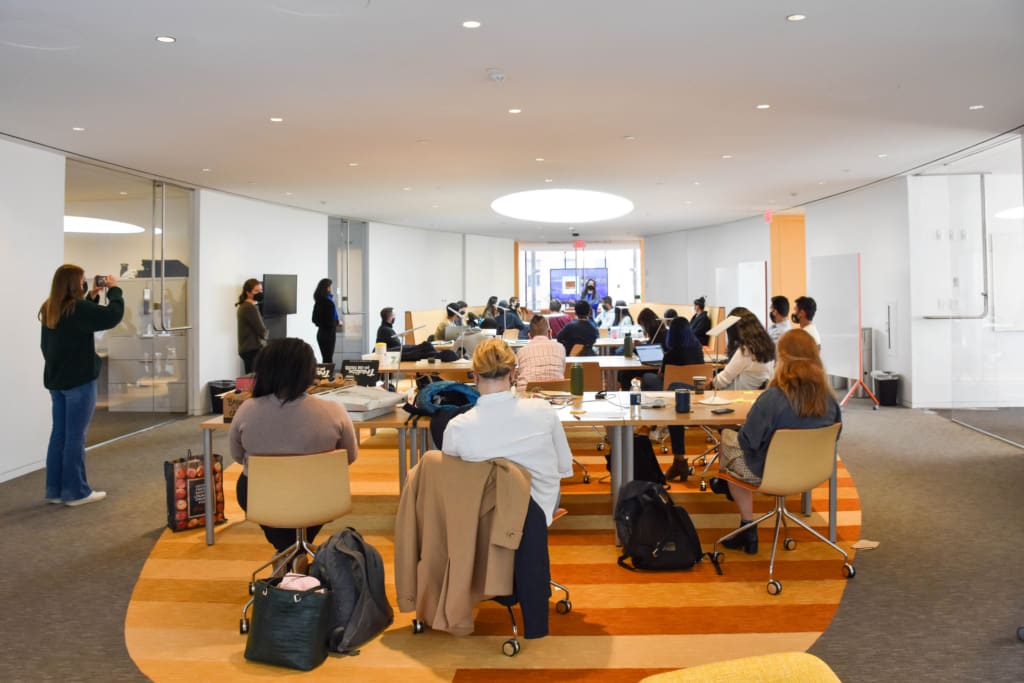
Students collaborate on startup ideas at Yale’s Tsai Center for Innovative Thinking, known as Tsai CITY, a university-wide hub that connects business, engineering, and other students to launch new ventures.
‘SET-JETTING’ WITH ARTOPATH
When Zheng finishes a movie, he immediately opens IMDb to trace the director’s career or discover that two films he loves share a producer. He is fascinated with the web of influence behind a project and how creators collaborate, mentor, and inspire each other. He wanted a way to visualize that lineage instead of scrolling through what he saw as static credit lists.
During his honeymoon in Paris, Zheng and his partner, both fans of the Before trilogy, retraced scenes from Before Sunset. They stopped at Shakespeare and Company, walked the Promenade Plantée, and hunted down the café from the film.
“It struck me that the city wasn’t just a destination, it was a story we were walking through,” says Zheng, who . “That feeling of fictional art becoming so vivid is what I wanted to capture for everyone.”
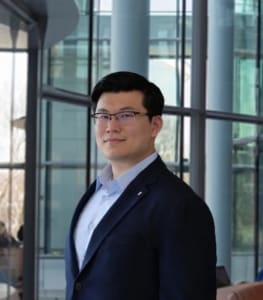
Austin Zheng
Artopath users can scan an artwork or search for a film, and the application builds a detailed profile that shows where the information comes from and how confident the system is in each claim. As users save more works, the app maps connections onto a real-world map — highlighting filming locations, museums, and studios they can visit. In short, it turns art and media consumption into what Zheng calls “set-jetting” exploration.
He is now working toward an MVP launch in time for Startup Yale 2026.
Not long ago, Zheng probably wouldn’t have tried building Artopath at all, but Yale SOM provided him both the encouragement and the technical runway. In Jensen’s Large Language Models course, Zheng dug into the mechanics behind generative AI. Management of Software Development instilled what Zheng calls a “shipping mindset” built on rapid prototyping and iteration. Empirical Strategy Lab introduced him to Yale’s high-performance computing, and his current Computer Science course is pushing him toward more durable system design.
“Traditionally, SOM students are known for being strong at frameworks and business decisions, but we haven’t always focused on the actual building,” Zheng says.
“The shift is very noticeable, and it feels like a shift toward a builder culture that spans schools. The stronger collaboration between schools, combined with the era of AI, gives us a unique advantage to collaborate with specific domains to actually create products.”
DON’T MISS: CHALLENGING INEQUITY IN MBA ADMISSIONS: A Q&A WITH SAAD KASSIS‑MOHAMED AND POLITICAL PRESSURE TESTS THE PHD PROJECT – BUT ‘THE MISSION CONTINUES,’ CEO SAYS
The post Yale SOM Deepens Engineering Ties To Train A New Generation Of Tech-Savvy Business Leaders appeared first on Poets&Quants.